

Nearly all homeowners now turn to online reviews before hiring a roofing contractor, yet most stop at star ratings without knowing what else to look for. 97% of consumers read online reviews for local businesses, including high-stakes services like roofing. The problem is that a shiny 4.8-star average tells only part of the story. This guide walks you through the real reasons reviews matter, how to read them strategically, and how to combine them with other checks so you hire a contractor you can trust with one of your home's most critical systems.
Table of Contents
- The numbers behind roofing company reviews
- How reviews reduce homeowner risk
- Review factors: Recency, volume, and platform reliability
- Common pitfalls: Reviews aren't everything
- Putting review knowledge into action
- A smarter homeowner's approach to reviews
- Build confidence with RidgeIQ's contractor tools
- Frequently asked questions
Key Takeaways
| Point | Details |
|---|---|
| Review volume boosts trust | Roofing companies with more recent, positive reviews are perceived as more reliable and close more jobs. |
| Specific reviews beat generic | Reviews detailing professionalism and project specifics help homeowners gauge contractor quality. |
| Google reviews drive visibility | Google reviews are crucial for contractor discoverability and outperform other platforms. |
| Verified platforms reduce risk | Recent, verified reviews on credible platforms minimize selection risks for costly projects. |
| Supplement reviews with vetting | Combine online reviews with direct checks for licenses, warranties, and site visits for best results. |
The numbers behind roofing company reviews
With the groundwork laid, let's dig into why reviews are more than just numbers. They directly affect your experience and the outcomes you get from a roofing project.
The data is striking. 67% of homeowners find online reviews very or extremely important when selecting a roofing contractor. That means reviews have moved from a "nice to have" into a core part of the decision-making process. When you're spending thousands of dollars on a new roof, that shift makes complete sense.
"Companies with 50+ positive reviews close up to 30% more roofing jobs than competitors with fewer reviews."
That statistic should tell you something important: contractors who earn and maintain strong reviews win more business, which usually means they're doing something right. Volume of reviews signals consistency, not just one or two lucky jobs.
Here are three numbers that define trust and choice in roofing:
- 76% of homeowners won't consider a contractor with less than a 4-star average rating
- 50+ positive reviews correlate with a 30% higher job close rate for roofing companies
- 67% of homeowners rank reviews as a very or extremely important factor in their final hiring decision
To see how reviews compare across different contractor performance indicators, here's a quick breakdown:
| Review factor | Low performing contractor | High performing contractor |
|---|---|---|
| Average star rating | Below 4.0 | 4.5 or above |
| Total review count | Under 20 | 50 or more |
| Review recency | Mostly 1+ years old | Within last 3 months |
| Response rate to reviews | Rarely responds | Consistently responds |
| Detail level in reviews | Generic praise | Specific project details |
The table makes it easy to see why reviews function as a quick screening tool. A contractor with 200 reviews averaging 4.7 stars, with the owner responding to feedback, signals a business that cares about reputation and customer experience. You can explore more on this topic through our roofing software guides and learn how technology is changing how contractors earn and manage reviews.
Understanding satellite measurement accuracy is another way to assess whether a contractor is using modern, reliable tools, which often shows up in detailed customer reviews praising precision and professionalism.
How reviews reduce homeowner risk
Numbers are important, but ultimately reviews impact your sense of trust and risk. Roofing is one of the most expensive home improvement projects you'll ever undertake. A full replacement can cost anywhere from $8,000 to $25,000 depending on your home's size and the materials used. That price tag alone makes risk reduction essential.
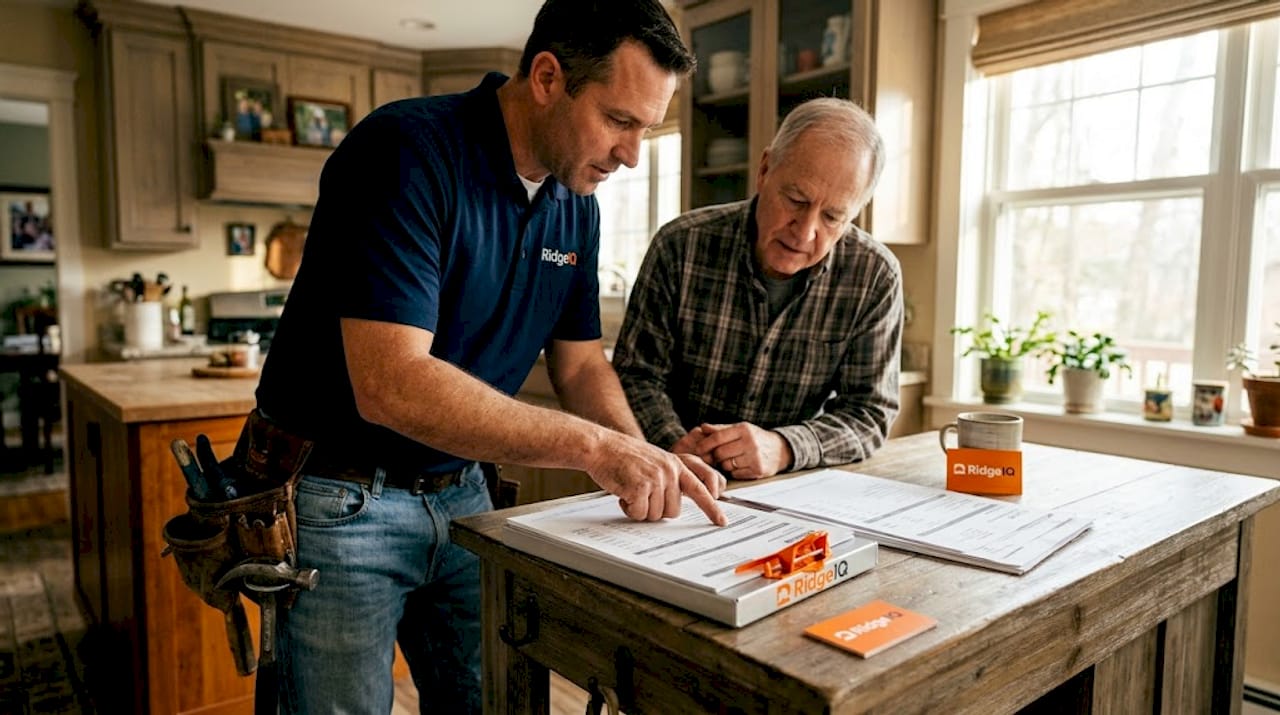
Reviews work as third-party validation. When a stranger describes how a crew arrived on time, protected their landscaping, and cleaned up every nail from the yard, that's real information you can use. Reviews reduce perceived risk for high-cost roofing projects by providing third-party validation of claims like timeline adherence and crew professionalism.
What makes a review genuinely useful? Specificity. Detailed reviews mentioning specific aspects like timeline, professionalism, and cleanup are 3x more persuasive than generic ones. A review that says "great job!" tells you almost nothing. A review that says "the crew arrived at 7 a.m. sharp, finished a 2,400 sq. ft. roof in one day, and left our driveway cleaner than they found it" tells you everything.
"The most valuable review you'll read isn't the one with five stars. It's the one that describes exactly what the job felt like from start to finish."
Here's how to interpret reviews for risk reduction, step by step:
- Filter for specificity. Skip vague reviews and focus on ones that mention project type, timeline, crew behavior, and post-job cleanup.
- Read the negative reviews carefully. One or two complaints are normal. Look for patterns. If three different reviewers mention the same problem, take that seriously.
- Check the contractor's responses. A contractor who responds professionally to criticism shows accountability. One who ignores or argues with reviewers is a red flag.
- Look for reviews on projects similar to yours. If you need storm damage repair, find reviews from homeowners who had the same type of work done.
- Note how long ago the work was done. A review from four years ago may not reflect the company's current crew or management.
Pro Tip: Don't just count stars. Search for the word "cleanup" or "timeline" in the reviews of any contractor you're seriously considering. Those two words reveal more about a contractor's professionalism than any rating ever will.
If you're also evaluating the tools contractors use to manage their projects and communicate with clients, check out resources on Roofr alternatives and small contractor CRM options that help contractors stay organized and professional.
Review factors: Recency, volume, and platform reliability
Understanding risk and trust leads naturally to evaluating review quality and platform influence. Not all reviews carry the same weight, and not all platforms are created equal.
Here's a number that surprises most homeowners: 74% of consumers only consider reviews from the last three months, and 47% won't use a business with fewer than 20 reviews. This means a contractor with 100 reviews from three years ago may actually be less trustworthy than one with 30 reviews from the past six months. Recency signals that a contractor is still actively working and still earning positive feedback.
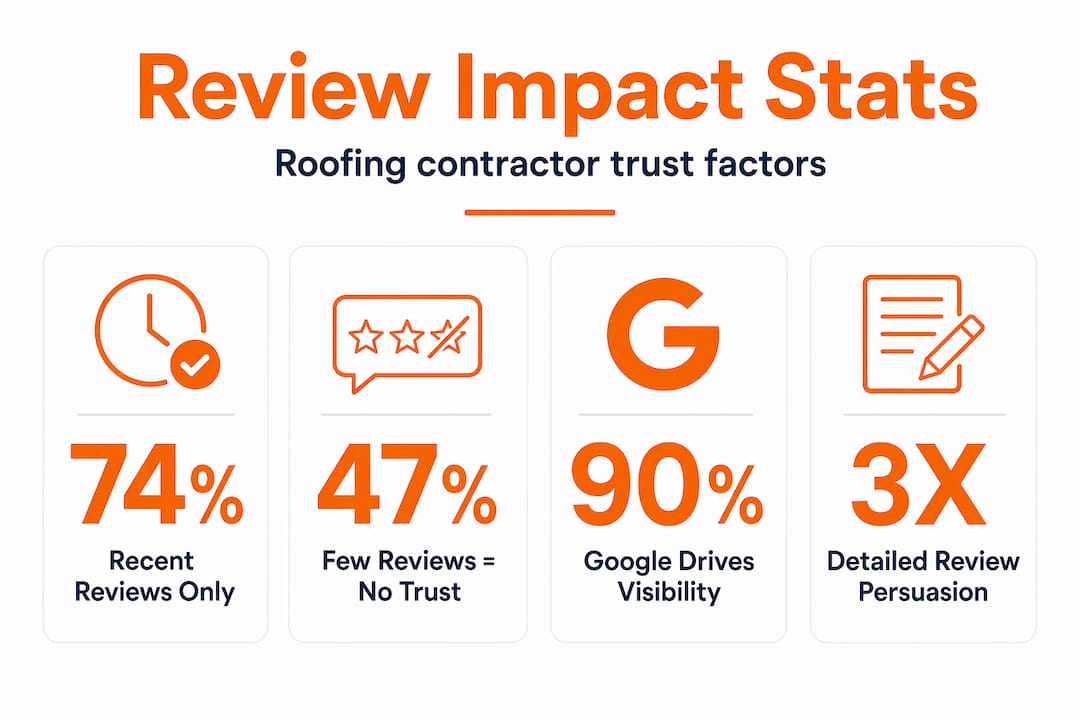
Platform matters too. Google reviews drive 90%+ of local search visibility for contractors, outperforming Yelp, Angi, and BBB, which do not appear directly in Google results. This is critical because when you search for a roofer in your area, the Google Business Profile results are what you see first. A contractor with strong Google reviews is more visible, more trusted, and more likely to show up when you need them.
Google Business Profile reviews also boost local search map pack rankings, which means contractors who actively collect Google reviews get found more often. That's a healthy incentive for good contractors to keep performing well.
Here's a platform comparison to help you prioritize where to look:
| Platform | Impacts Google search | Verified reviews | Homeowner traffic | Best use |
|---|---|---|---|---|
| Yes, directly | Partially | Very high | Primary research | |
| Yelp | Limited | Partially | Moderate | Secondary check |
| Angi (formerly Angie's List) | Limited | Yes | High | Background research |
| BBB | No | Yes | Low to moderate | Complaint history |
| No | No | Moderate | Community feedback |
Review scoring methodologies prioritize volume, recency, verification, and weighting over simple averages to detect manipulation and ensure reliability. This means platforms that use smart scoring are harder to game. A contractor can't just collect 50 reviews in one week and expect the algorithm to treat them the same as 50 reviews earned over 18 months.
Key factors to look for when evaluating review quality:
- Recency: Prioritize reviews from the last 90 days
- Volume: 20 reviews is a minimum; 50+ is a strong signal
- Platform: Weight Google reviews most heavily
- Verification: Look for platforms that confirm the reviewer actually hired the contractor
- Response pattern: Active, professional responses from the contractor indicate engagement
For homeowners who want to understand how contractors use technology to manage their reputation and lead generation strategies, the connection between strong reviews and modern business tools is worth exploring.
Common pitfalls: Reviews aren't everything
As you deepen your understanding, you must also realize what reviews don't capture about contractors. This is where many homeowners make a costly mistake: they treat a high review score as a green light without doing any additional homework.
Online reviews are not sufficient alone and may miss workmanship quality, warranties, and installation details. A contractor can have great customer service but cut corners on underlayment installation. They can be friendly and communicative but use substandard materials. Reviews rarely capture these technical details because most homeowners don't know what to look for during or after installation.
"A five-star review from a happy homeowner doesn't guarantee the flashing was installed correctly or that the warranty is actually transferable."
What reviews typically miss:
- Licensing and insurance status: A contractor can be charming and well-reviewed but operating without proper credentials in your state
- Warranty terms: Reviews rarely mention whether the workmanship warranty is 1 year or 10 years, or whether it's backed by the manufacturer
- Material quality: Homeowners often can't distinguish between a premium shingle and a builder-grade one, so reviews don't reflect this
- Subcontractor use: Some contractors outsource work to crews they don't directly manage, which may not show up in reviews
- Code compliance: Whether the job passed local inspection is almost never mentioned in a review
Pro Tip: Cross-check reviews on at least two platforms before making a final decision. Then verify the contractor's license on your state's contractor licensing board website and ask for proof of liability insurance and workers' compensation coverage. This combination gives you a much more complete picture.
Reviews should be cross-checked across platforms and supplemented with licenses, warranties, and site visits for comprehensive vetting. A site visit, even a brief one where you meet the project manager and see how they communicate, tells you things no review ever could.
For homeowners who want to understand how well-organized contractors operate, exploring CRM for small contractors gives insight into the tools that professional roofing companies use to stay accountable.
Putting review knowledge into action
With context, caution, and clarity, it's time to make reviews work for you. The goal isn't to spend hours reading every review. It's to build a smart, efficient process that helps you shortlist trustworthy contractors quickly.
Here's a step-by-step approach to applying review insights:
- Start with Google. Search "[your city] roofing contractor" and look at the map pack results. Filter for contractors with 4.5+ stars and 30+ recent reviews.
- Read 10 to 15 reviews per contractor. Don't read all of them. Focus on the most recent ones and any reviews that mention your specific project type.
- Flag red flags immediately. Repeated complaints about no-shows, poor cleanup, or billing disputes are disqualifying. Move on.
- Shortlist two to three contractors. Use reviews to narrow the field, then schedule estimates with your top picks.
- Ask review-informed questions during estimates. If a review mentioned cleanup issues, ask the contractor directly how they handle end-of-day site management.
- Verify credentials after shortlisting. Once you have two or three strong candidates, confirm licenses, insurance, and warranty terms before making a final decision.
- Check for contractor responsiveness. Did they respond to your inquiry quickly? Did they show up on time for the estimate? These behaviors mirror what you'll experience during the job.
Pro Tip: Use reviews as a shortlisting tool, not a final verdict. They help you eliminate bad options fast. Your final decision should always include a face-to-face conversation and a written contract that spells out scope, timeline, materials, and warranty terms.
Platforms like RidgeIQ help contractors stay organized and responsive, which is exactly the kind of professionalism that earns strong reviews in the first place.
A smarter homeowner's approach to reviews
Now, let's step back from the how-to and examine what actually works best in practice. Most homeowners approach reviews the same way: they glance at the star rating, skim a few comments, and make a gut call. That's not entirely wrong, but it leaves a lot of value on the table.
The conventional wisdom is that a high star rating means a contractor is reliable. The reality is more nuanced. True reliability is triangulated. It comes from combining review signals with direct observation, credential verification, and a clear written agreement. Reviews are one leg of that triangle, not the whole structure.
What separates a review-savvy homeowner from everyone else is the ability to read between the lines. When a contractor has 200 reviews and responds to every single one, including the critical ones, that's a signal of operational maturity. When a contractor has 15 reviews and hasn't responded to any of them, that's a signal of either disorganization or indifference.
The most underrated review signal is the negative review response. A contractor who says "I'm sorry you had that experience, here's my direct number, let's make this right" is showing you exactly how they handle problems. And problems happen on every roofing job. What matters is how the contractor responds when things don't go perfectly.
We've also seen that homeowners who combine review research with lead generation wisdom and an understanding of how modern contractors operate tend to make better hiring decisions. The best contractors use technology to stay organized, communicate clearly, and follow up consistently. Those behaviors show up in reviews, but only if you know what to look for.
The smartest move you can make isn't finding the contractor with the most stars. It's finding the contractor whose reviews tell a consistent story of professionalism, communication, and accountability across dozens of real jobs.
Build confidence with RidgeIQ's contractor tools
If you want tools that amplify your confidence and streamline the vetting process, RidgeIQ offers solutions that put review insight into practice.
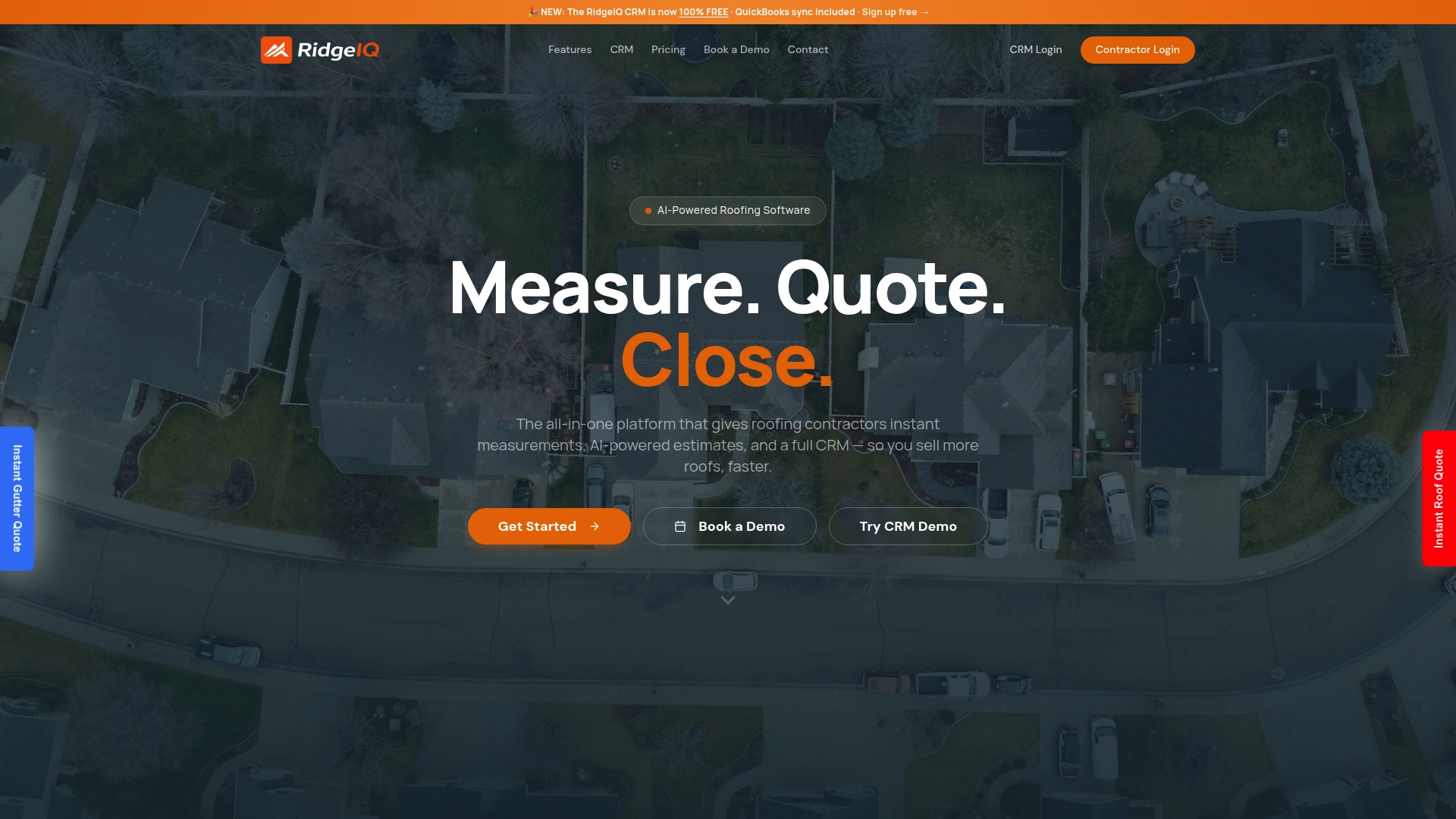
RidgeIQ is built for roofing and gutter contractors who want to operate professionally and earn the kind of reviews that win homeowner trust. The platform includes AI-powered property measurements, instant online quotes, CRM tools, and integrations with systems like JobNimbus and AccuLynx. When contractors use tools that keep them organized and responsive, it shows up in the reviews their customers leave. Start with a free roofing CRM to see how the right software changes the way contractors work and how homeowners experience them. You can also compare RidgeIQ vs Roofr or compare RidgeIQ vs EagleView to understand how different platforms support contractor professionalism and review-worthy service delivery.
Frequently asked questions
How many reviews does a roofing company need to be considered trustworthy?
Most homeowners prefer contractors with at least 20 recent reviews, since 47% of consumers won't use a business with fewer than 20 reviews and 74% only trust reviews from the last three months.
Do reviews on Google matter more than other platforms?
Yes. Google reviews drive 90%+ of local search visibility for contractors, making them far more impactful than Yelp, Angi, or BBB for both homeowner discovery and contractor credibility.
What details make a review most useful for homeowners?
Detailed reviews mentioning timeline, professionalism, and cleanup are three times more persuasive than generic feedback, giving you real insight into what working with that contractor actually looks like.
Should I rely solely on reviews to choose a roofing contractor?
No. Online reviews alone may miss workmanship quality, warranty terms, and installation details, so always combine review research with license verification, insurance checks, and a written contract.